
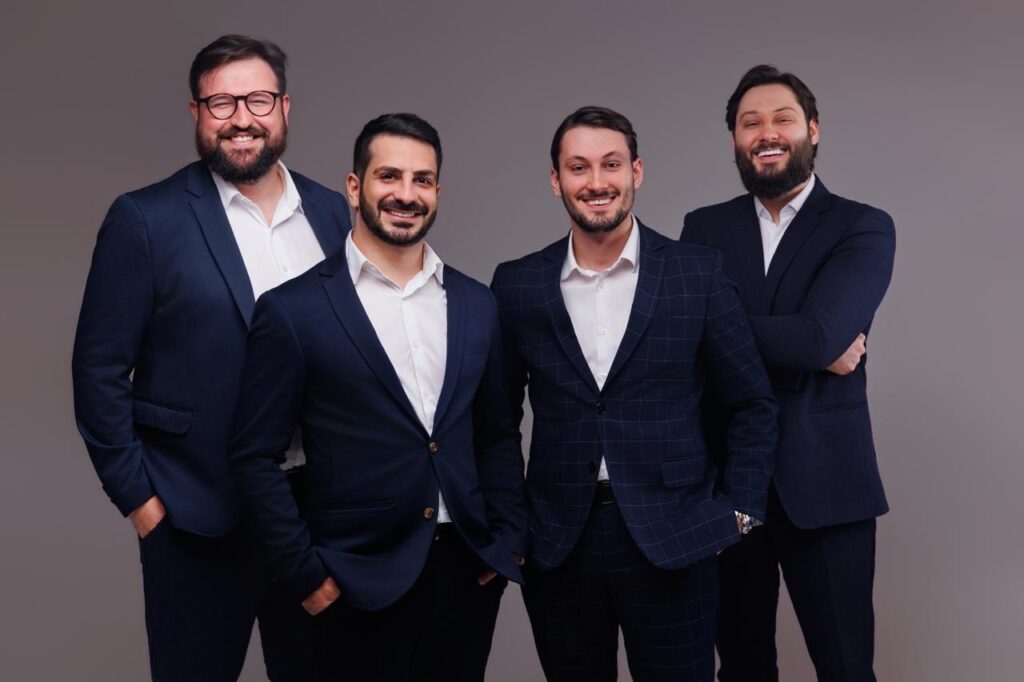
Four Partners, One Thesis: How Formadores de Mercado Built One of Brazil’s Most Consistent Digital Asset Operations
From Jaraguá do Sul, the city with the highest concentration of billionaires per square kilometre in Brazil, the company has consolidated a thesis that combines efficiency in international foreign exchange with performance exceeding that of the country’s leading investment firms.
There was a time, not so long ago, when mentioning stablecoins and crypto assets to a Brazilian entrepreneur with substantial wealth was the fastest way to lose credibility in the room. João Carelli knew this. That was precisely why he continued.
It was not that he ignored the scepticism. He understood where the distrust came from: a market damaged by a lack of information, collapsed exchanges and schemes that used the language of cryptocurrency to perpetrate financial fraud. The scepticism was rational and justified. The real question was what to do with it.
The answer Carelli and his three partners developed in Jaraguá do Sul, in the interior of Santa Catarina, was an educational and operational structure designed to provide security and results that are now recognised as exceeding those delivered by the leading traditional firms in Brazil’s investment market.
Four Areas, One Architecture
Formadores de Mercado was not created during a period of market euphoria. It emerged from a perception shared by its founders regarding a problem that nobody was addressing effectively: Brazilian entrepreneurs are highly capable of generating cash, but they have rarely received adequate preparation to structure, preserve and protect the wealth they have accumulated.
The solution involved building an organisation around four pillars, led by four partners whose responsibilities do not overlap.
João Carelli, CEO, leads the strategic vision and business development. Julio Carelli, CSO, is responsible for commercial intelligence and delivering value to clients. Rodrigo Peixer, CMO, oversees brand development and the communication strategy that has made the company recognised far beyond Santa Catarina. Willian Alif, CFO, ensures the financial strength and governance of the operation.
Each pillar has a leader. Each leader has autonomy. This clear division of responsibilities is the foundation of the company’s consistency.
The Foreign Exchange Model Banks Would Prefer You Not to Know About
For many Brazilian entrepreneurs who need to transfer resources abroad, whether to pay suppliers, capitalise international holding companies or protect wealth in US dollars, the cost of foreign exchange through a traditional bank is rarely questioned.
It should be.
A foreign exchange transaction conducted through the conventional banking system may carry a spread of between 3 and 5 per cent, in addition to IOF tax of 3.5 per cent applied to the total amount. On a transfer of R$1 million, this can mean as much as R$85,000 disappearing before the money even crosses the border.
Formadores de Mercado processes the same flow using stablecoins, digital assets backed by the US dollar that move through blockchain infrastructure.
The practical result is a total cost of between 1.5 and 2.9 per cent, with no IOF tax and settlement completed within hours rather than several working days.
For an entrepreneur making regular international transfers, the difference accumulated over the course of a year is not marginal. It is structural.
Efficient foreign exchange, however, is only the entry point.
The Family Office Model Brazil Never Offered
Historically, the family office model, a structure dedicated to integrated wealth management, succession planning, asset protection and capital allocation, has been restricted to families with assets exceeding R$30 million or R$50 million.
Below that threshold, entrepreneurs were frequently left dependent on bank managers driven by product targets and investment advisers operating under structural conflicts of interest.
The central thesis of Formadores de Mercado is simple to explain but complex to execute: to democratise access to this level of financial sophistication.
The company serves clients with at least R$500,000 available for investment, offering them the same sophistication, diversification of instruments and alignment of interests that were previously reserved exclusively for the wealthiest families in the country.
In practice, this means providing clients with an allocation architecture that combines structured fixed income, exposure to digital assets with active risk management and integrated foreign exchange solutions.
Everything operates within a strategy focused on preserving and growing wealth rather than promoting the financial product of the month.
The Figures That Validate the Thesis
The market may question narratives. Numbers are considerably more difficult to ignore.
Since February 2024, Formadores de Mercado has recorded an average performance of 103 per cent across its recommended portfolios, a figure that consistently positions the operation above the principal benchmarks in Brazil’s investment market.
Even considerably more aggressive portfolios rarely approach this level of performance over the same period.
More than 7,000 clients.
More than R$200 million in results generated.
All built from Jaraguá do Sul, a city that has already demonstrated to Brazil that geographical size and economic relevance are entirely independent variables.
Carelli does not use the word disruption. He prefers consistency.
“Anyone can achieve a good result once. What matters to us is what happens during the tenth or the fiftieth transaction. That is when the structure reveals whether it is real.”
The strength of the operation has not gone unnoticed by the market.
Formadores de Mercado has received a validated valuation of R$112 million, a figure endorsed by João Kepler, one of the most respected investors in Brazil’s entrepreneurial ecosystem and a national authority in the valuation of high growth businesses.
For a company built outside the country’s principal financial centres, without institutional venture capital and without the advantage of an established banking brand, the figure says less about vanity and more about what the market sees when examining its fundamentals: a loyal client base, a profitable operation and a thesis with significant room for further growth.
The question once surrounding the business, whether it was possible to build a relevant digital asset operation grounded in rigour, transparency and measurable results, has already been answered.
The next question is considerably larger: how long will it take before the major players recognise the transformation being driven by digital assets?